



Sermons & Homilies

You who gave a little, and you who gave a lot, are the reasons we are in this church today. You have given to the monastery, but you have also given to God, and at each Liturgy, you are all commemorated, because by building churches on earth, you secure the eternal habitation in heaven for yourself.

Around the year 271, there was a young man who lived in Lower Egypt, born to wealthy landowner parents, both of whom had only recently died, leaving the young man to care for his little sister and the upkeep of the family home. This young man went to church one day, and while there, he heard the Gospel which we have just heard. Writing about this experience, his friend says that the young man realized this passage had been read for his sake and he immediately left the church, gave away all the land that he had inherited, and then sold his possessions, distributing the money to the poor, and saving some for his sister. This young man we know as St. Antony the Great, and his friend and biographer is St. Athanasius of Alexandria. Originally, St. Antony’s Life was written in Greek, but within twenty years it was translated twice into Latin, then into Coptic and Syriac, and became the impetus for many who desired that perfection which comes to those who leave their homes to make the desert a city.

What is the state of our heart? In today’s Gospel our Savior presents the parable of the Sower in order to get us to ponder this question. What is the state of our heart? Are we able to bear spiritual fruit? This is the most important question of our life, and we need to be constantly reminded to keep it front and center.

“God is the infinite fulfillment of our desire, both in this life and in eternity,” thus writes St. Ignaty Brianchaninov. Unlike Buddhism, Christianity does not see desire as the root of all suffering but rather sin is. God created us to desire Him and implanted in our hearts an infinite desiring capacity to be able to contain Him insofar as we are able. But in the Fall, man turned away from God and chose to satisfy his desires not for spiritual delights, but for fleshly ones. In our own sinfulness we see our desire for the temporal trump the eternal.
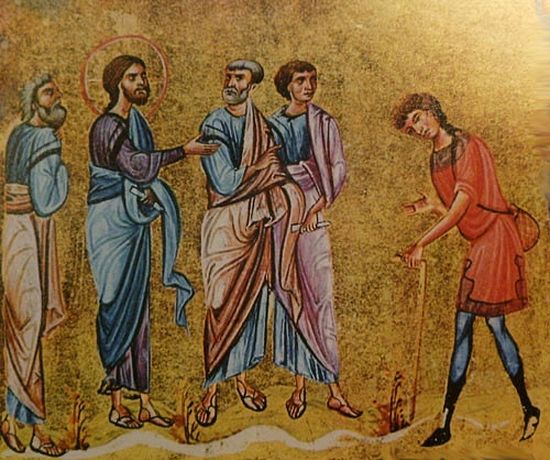
“The rich man shall hardly enter the Kingdom of heaven.” That is, only with great difficulty. These are strong words from our Lord. So strong that even the Apostles who, as St. Peter testified directly after today’s Gospel reading, left everything to follow Christ—not simply possessions, but family, relatives, wife, children, lands, and property; everything!—even they responded: “Who then can be saved?!”


